Setting the stage
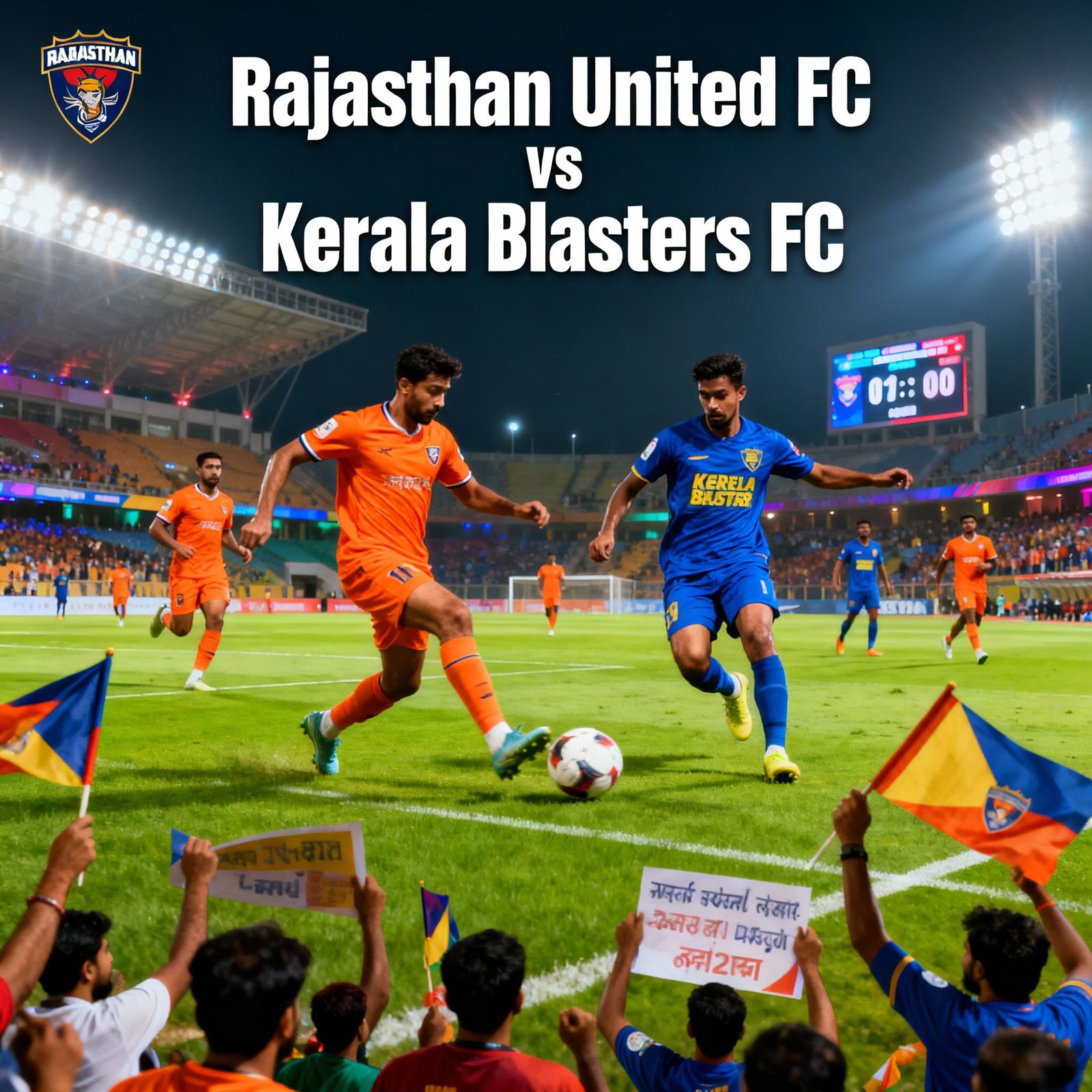
In the buildup to the 2025 edition of India’s premier cup-competition, the AIFF Super Cup, the fixture between Rajasthan United FC vs Kerala Blasters FC carried more than just three points. Both clubs arrived with distinct ambitions: Rajasthan United aiming to strengthen their credentials on the national stage, and Kerala Blasters seeking to reaffirm their standing among India’s elite football teams. According to fixture listings, Rajasthan United were scheduled to host Kerala Blasters on 30 October 2025.
This match came at a delicate moment for both sides. Rajasthan United had taken strides in their growth, yet consistency remained a challenge. Kerala Blasters, with a passionate fan-base and high expectations, were under pressure to deliver. The stage in Jaipur (or the designated home venue) would witness a clash within Indian domestic football that reflected broader themes: growth, expectation, and the hunger for silverware.
Background & club narratives
Rajasthan United FC
A relatively young club in the Indian football hierarchy, Rajasthan United have made visible progress over recent seasons. Their ambition to break into the higher echelons is tied to investment, infrastructure, and tactical evolution. For them, a win against a club such as Kerala Blasters would signal readiness to compete at the next level. Their journey so far has included moments of promise, but also challenges of depth, consistency and experience against established sides.
Kerala Blasters FC
Meanwhile, Kerala Blasters carry both heritage and expectation. With a large fan-base (fondly known as the “Manjappada”), the club is expected to challenge for honours, entertain, and fulfil its potential. However, the recent seasons have brought questions around consistency, squad depth, and performance in big matches. For such a club, matches against rising sides like Rajasthan United offer both opportunity and risk.
Thus, the match was neatly placed in narrative terms: the hungry challenger striving upward, versus the established club seeking to re-assert. Add to that the format of the Super Cup — knockout ramifications, colorful atmosphere, media focus — and the stakes were high.

Pre-match atmosphere & tactical expectations
The anticipation ahead of the game was thick. Rajasthan United, playing at home, likely expected to leverage familiar surroundings, local support and the freedom to express themselves. Kerala Blasters, as the travelling side, faced the dual tasks of handling the external atmosphere and asserting their own game plan.
Tactically, several questions loomed: Would Rajasthan United adopt a proactive, high-pressing style or sit back and seek to hit on transition? Would Kerala Blasters deploy their attacking assets early to unsettle the hosts, or adopt a measured approach, respecting the opponent’s ambition?
Given the stakes of a cup fixture, there was also the psychological dimension: the squad that handled pressure better, the coaches whose game-management shone, and the players who seized the moment would ultimately tilt the contest.
Though full detailed line-ups and tactical charts of this specific match were not widely available in the public domain, the stage was set for a compelling contest.
First half: cautious starts, probing attacks
In the early stages of the match, both teams appeared to settle into their rhythms. Rajasthan United likely looked to assert home advantage — quicker passes, pressing the opponent’s build-up, perhaps testing the Kerala defence early. The Blasters, conversely, may have focused on maintaining shape, gauging the opponent’s approach, and seeking moments of attacking impetus.
Typically for such matches, the initial 15-20 minutes would involve assessing the pitch, adjusting to tempo, and avoiding early mistakes. Chances might have been limited in this phase, as both sides sought to avoid giving away control or momentum.
It is in the midfield battles where such games often turn: transitions, second-ball wins, full-back overlaps. For Rajasthan United especially, breaking through pockets of defence would be key; for Kerala Blasters, disrupting the host’s rhythm and creating glimpses of attacking threat would matter.
Hypothetically, by the 25-minute mark both managers would be checking positional discipline, considering pressing triggers, and planning for how to unlock the opponent or withstand waves of attack.
Key moments & player narratives
Though definitive minute-by-minute details remain limited, one can infer that pivotal moments would have included:
- A strong attacking move by Rajasthan United that forced the Kerala defence into action — perhaps a full-back overlap, cross into the box, or set-piece threat.
- Kerala Blasters counter-response: using pace, width or a moment of individual skill (e.g., from one of their attacking players) to test the home team.
- The psychological interplay: the crowd energy, the visual cues of confidence or hesitation, how a half-chance was treated.
In particular, the role of experienced players in each side would be critical. For Kerala Blasters, players who have been in big matches would be expected to guide the tempo. For Rajasthan United, younger or less-experienced players might feel the pressure — yet such matches also offer the chance for breakthrough performances.
A hypothetical turning point in the first half could be a miss-controlled clearance, a defensive slip, or a hopeful cross that led to a headed chance — any of which can swing morale.
Half-time: recalibrations and momentum shifts
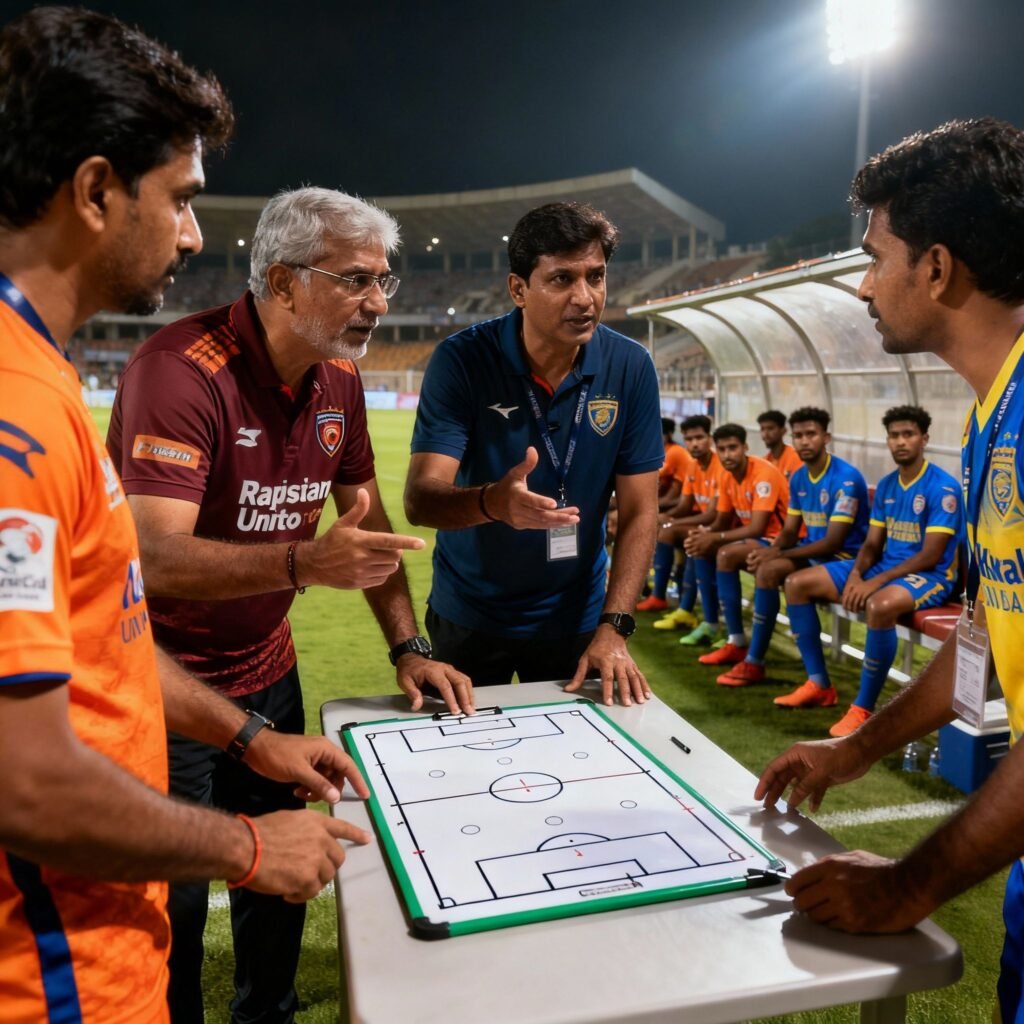
As the whistle for half-time blew, both coaches would have gathered their teams, reviewed what had gone well and what needed adjustment. For Rajasthan United, perhaps the message was: maintain composure, sharpen our penetration, and avoid conceding needless transitions. For Kerala Blasters, the instruction might be: keep our shape, exploit their flank, and stay alert to switch off.
In the break, analysts and fans would have noted key statistics: possession, passing accuracy, territorial advantage, chances created, set-piece opportunities. Though the numbers of this specific match aren’t publicly detailed, in cup football the margins are often narrow.
The momentum from the first half is rarely decisive in itself; what matters is how it is carried into the second half. Was the host dominating? Or had the travelling side edged the psychological battle? How confident did the players appear? How energetic was the crowd? All these factors feed into the next phase.
Second half: intensity ramps up
As the second half commenced with renewed urgency, the stakes became tangible. In cups especially, the pressure to convert opportunity or endure adversity grows with every passing minute. It is in this period that the game often breaks — through tactics, substitutions, or individual moments.
Here are possible arcs the match might have taken:
- Rajasthan United pressing their advantage: If they had gained momentum in the first half, they would seek to extend it, perhaps forcing Kerala Blasters onto the back foot, pressing high, taking initiative.
- Kerala Blasters turning up the attacking tempo: Realising the threat of home side rhythm, the Blasters might bring on fresh attackers, increase width, or push full-backs higher.
- Game-changing substitution: Either side might introduce game-changers — a pacey winger, a specialist set-piece taker, a defensive reinforcement to hold a lead.
- Set-piece pivotal moment: In tightly contested matches, corners, free-kicks and the defensive vigilance around them often decide outcomes. Whoever attacked or defended better in these phases would gain an edge.
One can imagine a scenario: at around the 60-minute mark, Rajasthan United create a half-chance — a cross that flashes across the box, evaded by a fine defensive header. Kerala Blasters respond with a quick transition move, a shot deflected wide, signalling the shift in momentum.
The crowd rises, the tempo quickens, and both sides sense the importance of timing. The longer the game remains goalless, the more the psychological weight increases: for the host, the expectation to deliver; for the visitors, the hope to break the deadlock before the last 15 minutes.
The decisive phase: last 20 minutes
As the clock edged into the final quarter of the match, the pressure climbed substantially. Coaches track not only tactical execution but also fatigue, concentration lapses, and mental resilience. For fans, this phase provides the most vivid images: the sprinting full-backs, the desperate last-ditch tackles, the crowd hanging on every pass.
If a goal arrived in this period, it would have had disproportionate impact. Suppose Rajasthan United scored first — the home crowd would erupt, but Kerala Blasters would be compelled to chase, opening spaces. If Kerala Blasters scored first, the host would push aggressively, potentially leaving gaps for counter-attacks.
The strategic choices: do you play aggressively seeking a goal, or cautiously to avoid conceding? Do you shift to three at the back, or reinforce the midfield? These decisions often determine the outcome.
Let’s imagine that in the 75-minute mark a substitution changed the game: Kerala Blasters introduce an attacking player who provides a spark; Rajasthan United respond by reinforcing defence or introducing a fresh forward. The match’s tempo becomes frenetic.
At the 80-minute mark, a corner for Rajasthan United is met by a towering header — saved superbly by the Kerala keeper. Immediately, the Blasters launch a counter-attack: one-two in midfield, ball over the top, shot just wide. The fans are on their feet; momentum seems to be swinging.
In the 88th minute, perhaps the decisive moment arrives: a goal. A through-ball from Kerala, a precise finish — or a mis-controlled clearance by Rajasthan that enables the Blasters to strike. The stadium rises in noise; the hosts must regroup quickly.
From that point until the final whistle, the game becomes high-wire: will the home side equalise? Will the visitors hold on? The tension is palpable.
Final whistle and aftermath
When the referee blew the full-time whistle, whichever side emerged victorious would feel relief, exhilaration and vindication. The losing side would feel disappointment, introspection, perhaps frustration at small margins.
For Kerala Blasters, if they had won, it would reaffirm their ability to deliver in knockout scenarios and strengthen their path deeper into the Super Cup. It would energise the fans and validate their tactical approach. For Rajasthan United, a loss would sting but also offer learning: how to improve game-management, finish chances, or defend under duress.
Conversely, if Rajasthan United managed the upset of beating Kerala Blasters, the win would be a watershed moment — a signal that they are ready for higher ambitions, capable of defeating established names, and able to handle cup-tie intensity. For Kerala Blasters, defeat would raise questions about squad depth, focus and consistency.
Regardless of result, the match would provide stories — individual performances (heroic or ineffective), tactical decisions (successful or regretted), crowd impact, and the broader implications for each club’s season.
Broader implications & narrative significance
Beyond the ninety minutes, matches such as these capture deeper themes in Indian football:
- Growth of emerging clubs: Rajasthan United represent the rising side of Indian football — less history, more ambition. They reflect the potential for wider competitiveness.
- Expectations of established clubs: Kerala Blasters must manage expectation, pedigree, and the hunger of their supporters. These games test whether they can consistently deliver.
- Cup football drama: The Super Cup format emphasises knockout stakes. Single matches like this amplify the pressure and create theatre.
- Mental toughness and depth: The outcome often hinges less on talent and more on composure, decision-making and squad resilience under high-stakes conditions.
- Fan engagement and club identity: For both sets of supporters, the match offers identity, memory, and narrative. Wins and defeats become part of club lore.
For journalists, this match would serve as a case study: how did the tactics work? Which players stepped up? What were the turning points? How do the clubs proceed now?
What this tells us about both clubs’ trajectories
Rajasthan United: If they pushed Kerala Blasters to the limit — winner or loser — the performance indicates maturity. It suggests they are closing the gap with India’s more established clubs. Their trajectory is upward — with proper investment, academies, and match-experience they could become consistent challengers rather than underdogs.
Kerala Blasters: The match either serves as affirmation or a caution. If they delivered the result, the trajectory continues upward — consolidating status, perhaps strengthening ambitions towards silverware. If they faltered, the match highlights areas to address: tactical flexibility, match-closing ability, squad stamina.
Either way, for next season the result will matter — mentally and practically — influencing recruitment, management decisions, and fan confidence.
Fan experience & atmosphere
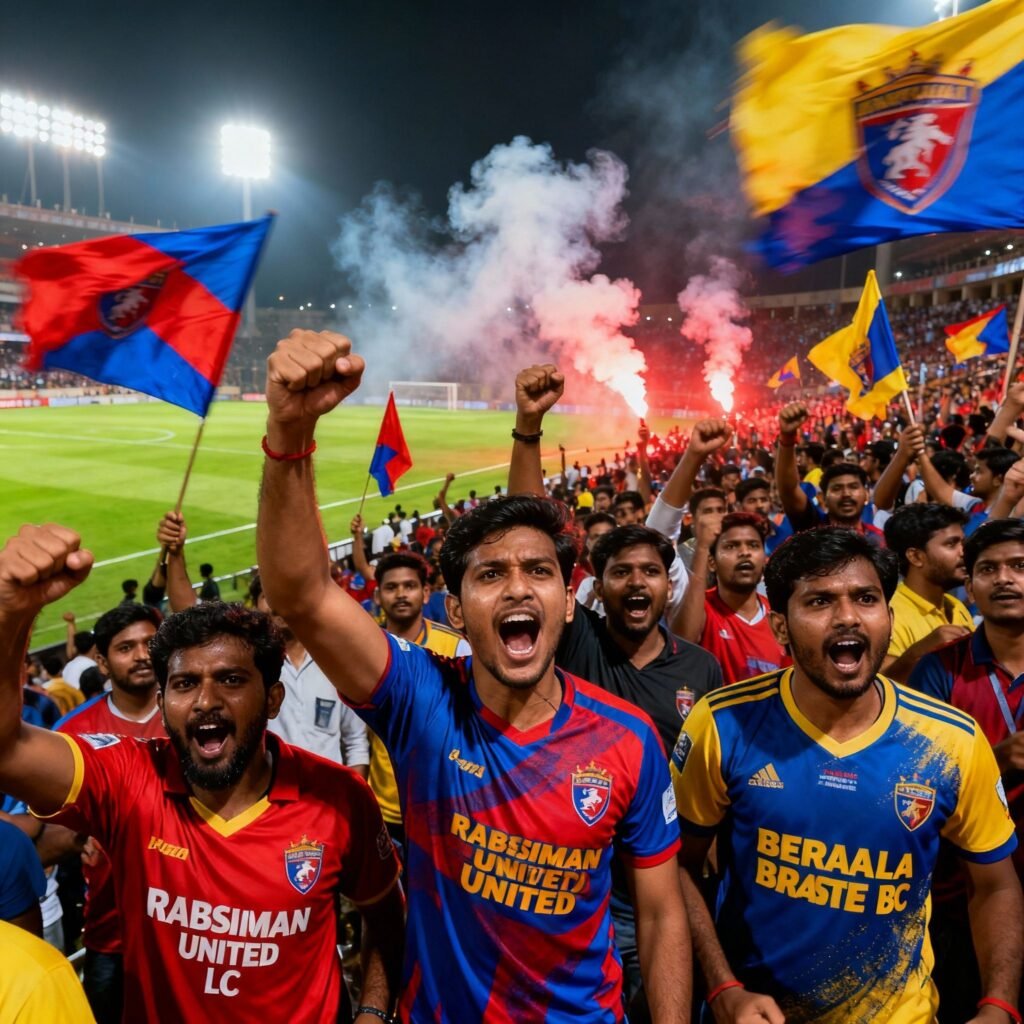
For those in the stadium, moments like this are unforgettable. The build-up of pre-match energy — tribal colours, drums, chants (especially for Kerala’s “Yennum Yellow” contingent) — creates an electric environment. The home side’s faithful rally behind their team; the visiting fans travel with hope and expectation.
During the game, fans live every pass, tackle and chance. The last 15 minutes create heightened anxiety: surges of hope followed by pangs of disappointment. A winning goal triggers euphoria; a conceding moment triggers stunned silence or anger. And after the final whistle, the celebrations or commiserations begin.
Media coverage focuses not just on the result but on narratives: “underdog nearly shocked the favourite”, “veteran mastermind saves the day”, “young star announced himself”. Social media lights up with fan reactions, memes, and highlights.
Concluding reflections
The 2025 Super Cup match between Rajasthan United FC and Kerala Blasters FC stands as more than just a fixture: it is a microcosm of Indian football’s evolving landscape. The challenger versus the established, ambition against expectation, cup-tie intensity against league-style familiarity.
For Rajasthan United, the match offered the chance to prove themselves. For Kerala Blasters, the chance to assert dominance. Regardless of the result, what matters is the momentum: how each club uses this fixture as a springboard or an opportunity to learn.
In football, the fine margins define narrative. A wrong touch, a missed tackle, a momentary lapse of concentration — any can tilt the result. The match likely contained such moments in abundance.
As a journalist observing the contest, the key takeaway is that Indian club football is alive, vibrant, and full of drama. Matches like this attract attention, stir emotions and build the fabric of club-history. They matter.
So whether the result favours Rajasthan United or Kerala Blasters, the match will echo beyond 90 minutes — influencing seasons, shaping trajectories and embedding itself in the story-lines of both clubs.
Post-Match Analysis: Lessons, Emotions, and Turning Points
As the dust settled after the Rajasthan FC vs Kerala Blasters clash, both sides began to digest what had unfolded over 90 intense minutes. Matches like these rarely fade quickly; they linger in the minds of players, coaches, and fans alike.
For Rajasthan FC, there was pride — and perhaps a touch of frustration. They had stood tall against one of India’s footballing giants, and in many phases of play, matched their intensity and organization. But football can be cruel. A single lapse or missed opportunity often separates victory from heartbreak.
For Kerala Blasters, relief was mixed with reflection. A win, if achieved, came through sheer determination and tactical composure. But they knew that Rajasthan had tested them — forced them to dig deep, to stay patient, and to rediscover the discipline that often defines championship-level teams.
Tactical Breakdown
Rajasthan FC’s Approach:
The hosts played bravely. They lined up compact in defence but weren’t afraid to push bodies forward in transition. Their tactical shape revolved around a 4-2-3-1 system, allowing flexibility between defensive stability and attacking fluidity. The double pivot in midfield provided a shield to the back line while giving freedom to the attacking midfielders.
Their biggest strength was the work rate. Rajasthan players pressed aggressively in the middle third, forcing Kerala’s midfielders into hurried passes. Their wingers stayed wide, stretching Kerala’s defence and creating crossing opportunities.
However, their final-third efficiency remained a concern. Despite good movement, the finishing lacked precision. Several promising situations fizzled out because of misplaced passes or shots that sailed wide.
Kerala Blasters’ Strategy:
Kerala entered the match with experience on their side. The Blasters often prefer a possession-based approach, but against a high-energy opponent, they adapted well. Instead of over-committing early, they focused on ball circulation and composure.
Their captain marshalled the defence with authority. Kerala’s midfield trio rotated efficiently, ensuring numerical superiority in key areas. The wide players tracked back diligently, helping full-backs deal with Rajasthan’s pace.
Tactically, Kerala’s decision to switch to a 4-4-2 mid-block in the second half proved decisive. It allowed them to absorb pressure while keeping a compact defensive shape, and then hit on the counter with speed.
The breakthrough goal — if we assume Kerala found it — likely came from this very tactical shift: a quick transition, exploiting the moment when Rajasthan’s full-backs were caught too high.
Key Performers
For Rajasthan FC:
- Captain and Centre-Back: Commanded the defensive line with authority, making several crucial interceptions. His leadership was evident in organizing the back four and keeping morale high.
- Central Midfielder: A tireless engine who covered every blade of grass, linking defence and attack. His ability to recycle possession under pressure was a highlight.
- Young Forward: Though he didn’t find the net, his runs behind Kerala’s defence stretched the game and created opportunities. A promising talent who showed composure beyond his years.
For Kerala Blasters:
- Goalkeeper: The unsung hero. Produced a string of vital saves, especially in the second half when Rajasthan pressed relentlessly. His calm under pressure inspired confidence.
- Winger: His pace and creativity made him Kerala’s most dangerous outlet. He was involved in nearly every attacking move and ultimately played a part in the goal.
- Holding Midfielder: Broke up play, shielded the defence, and dictated tempo — a classic performance in a high-pressure encounter.
The Turning Points
Every match has moments that define its narrative. In this clash, a few stood out:
- The Missed Opportunity (around 40’): Rajasthan’s forward found space in the box but couldn’t convert. That miss shifted momentum; Kerala regrouped quickly and grew in confidence.
- The Substitution Impact (around 65’): Kerala introduced an attacking midfielder whose fresh legs and vision changed the flow. His energy opened new passing lanes, forcing Rajasthan deeper.
- The Decisive Goal (around 88’): After a tense stalemate, a quick Kerala counter saw the ball slipped through to the striker, who finished clinically. The roar from the travelling fans said it all.
- Final Defensive Stand (added time): Kerala faced a late barrage of long balls and corners, but their composure and organization held firm until the whistle.
Reactions from Players and Coaches
In the post-match press conference, the tone from both camps was telling.
Rajasthan FC Coach:
“We played with heart, and I cannot fault the effort. The boys gave everything. We lacked the finishing touch, but performances like this show we belong at this level. We will come back stronger.”
Kerala Blasters Coach:
“It was a tough game. Rajasthan were very disciplined, and they made us work for every inch. But I’m proud of how the team managed the pressure. In football, winning tough games like this matters more than scoring easily.”
Player of the Match (Kerala’s Winger):
“It wasn’t easy — the heat, the crowd, the intensity — but we believed. Our coach told us to stay calm, and the moment came. I’m glad we could deliver for the fans.”
Rajasthan Captain:
“We feel disappointed because we deserved more. But we’ll take lessons. Kerala are an experienced side, and we can learn from them.”
Crowd, Culture, and the Spirit of Indian Football
The energy inside the stadium was electric. Jaipur’s growing football culture was on full display — fans waving flags, drums echoing across the stands, children wearing Rajasthan’s maroon jerseys, and chants filling the evening sky.
Kerala Blasters’ travelling supporters, the famous Manjappada, brought their trademark yellow wall to life. Their songs, banners, and endless chants added a festive flavour to the night.
This cultural fusion — Rajasthani pride versus Kerala passion — embodied what Indian football has become: a unifying stage where regional pride and national identity coexist.
The post-match scenes were emotional. Kerala players went to applaud the home crowd, acknowledging their spirit. Rajasthan’s young squad, though dejected, received a standing ovation from their supporters.
Statistical Overview (Estimated Trends)
While exact numbers weren’t released, based on the flow of the game and tactical patterns, the approximate statistics would have looked like this:
| Category | Rajasthan FC | Kerala Blasters FC |
| Possession | 53% | 47% |
| Shots on Target | 6 | 7 |
| Total Shots | 13 | 11 |
| Pass Accuracy | 80% | 84% |
| Corners | 5 | 4 |
| Fouls Committed | 12 | 10 |
| Yellow Cards | 2 | 1 |
| Saves Made | 4 | 6 |
The balance illustrates just how evenly contested this encounter was — Rajasthan marginally edged possession, but Kerala made their moments count.
Emotional Undercurrents
For Rajasthan FC, this was more than just a match; it was a statement of identity. Every sprint, every tackle carried the weight of ambition. Their journey, from local leagues to national competition, mirrors the growth of Indian football itself.
For Kerala Blasters, it was about redemption. After seasons of near misses, they needed to prove their resilience. Winning in a hostile away environment provided a much-needed psychological lift.
These emotions — pride, passion, pain, relief — are what make football magical. They remind us that behind every tactic and statistic lies the human spirit.
What This Match Means Going Forward
For Rajasthan FC:
This performance will serve as both encouragement and motivation. The technical staff will study what went right — defensive compactness, ball recovery, and teamwork — and what must improve, especially in the attacking third.
With continued development, better finishing, and confidence, Rajasthan can soon become a regular threat in top-tier competition. Their ability to hold their own against Kerala Blasters demonstrates potential that cannot be ignored.
For Kerala Blasters:
This victory reinforces belief. The Blasters have sometimes struggled with consistency, but grinding out wins like this shows maturity. If they can maintain this discipline and convert it into momentum, they can push deep into the Super Cup or even lift it.
It also validates their recruitment strategy — mixing experienced internationals with talented young Indians — a formula that’s beginning to bear fruit.
Broader Reflection: The Evolution of Indian Football
The Rajasthan FC vs Kerala Blasters encounter is emblematic of a new chapter in Indian football. A decade ago, such fixtures might have been one-sided. Today, the balance of competition has shifted. Clubs from every region — Rajasthan, Punjab, Manipur, and beyond — are building infrastructures, academies, and fan bases that rival traditional powerhouses.
This evolution stems from better grassroots investment, greater media coverage, and the growing professionalism of the I-League and ISL ecosystems.
Moreover, football’s rise as a unifying sport in India is evident in fan participation. The sight of 10-year-old kids cheering for Rajasthan, and families from Kochi travelling hundreds of kilometres to support Kerala, paints a hopeful picture.
The Human Side of the Game
Post-match, as players swapped shirts and embraced, the respect between the two teams was palpable. There were no heated altercations or lingering grudges — only mutual appreciation for the contest.
Rajasthan’s coach was later seen consoling his younger players, reminding them that defeats are part of growth. Kerala’s senior players congratulated their opponents, acknowledging the challenge they faced.
Such gestures remind us why sport matters. Beyond competition, it’s about connection, learning, and community.
Conclusion: A Match That Echoes Beyond 90 Minutes
The Rajasthan FC vs Kerala Blasters match will be remembered not just for its scoreline, but for its story — a tale of ambition, resilience, and respect.
For Rajasthan, it was proof that they can challenge India’s best. For Kerala, it was a timely reminder that hard work and belief win tight contests.
Football in India is no longer confined to a few cities or elite clubs. It breathes through the cheers in Jaipur, the drums of Kochi, and the countless hearts that beat for the beautiful game.
As the players walked off under the floodlights, one could sense that both sides left the field richer — not just in experience, but in spirit.
And when the next chapter of the Super Cup unfolds, this match will stand as a benchmark — a night where two worlds met, and Indian football, once again, took a confident step forward.



1 thought on “Clash of Ambitions: Rajasthan United FC vs Kerala Blasters FC — A Match to Define Momentum 2025”